Clear Aligners FAQ: Cost, Timeline, and Results in Charleston
Clear Aligners in Charleston: The Cost, Timeline, and Results Questions You're Actually Asking
If you're reading this, you've probably already gone deep into this subject. Reddit threads, before-and-after photos, a few late nights wondering whether the dentist you have in mind really knows what they're doing. You're not at square one. You're close to deciding, and that last stretch tends to be the most uncomfortable part, because the cost still feels fuzzy, the timeline feels vague, and there's that nagging worry you'll be halfway through treatment before something nobody mentioned comes up.
Before we dig in, here's the short version. Cost typically falls between a few thousand to several thousand dollars, depending on how involved your case is. Mild-to-moderate cases usually finish somewhere between 6 and 18 months. And clear aligners really do work, as long as you wear them 22 hours a day and don't talk yourself out of putting them back in.
Dr. Fischer and the team at Everything Dental built this practice on a simple idea: you shouldn't have to chase down basic facts about your own treatment. We're right off Clements Ferry Road in Charleston, serving Mount Pleasant and the Low Country, and we're happy to talk through your specific situation anytime at (843) 755-6602. If you'd rather read first, the clear aligner therapy page is a good next stop after this one.
The Short Version
- Cost: typically $2,500 to $6,000 out of pocket, driven mostly by how many trays your case needs, not just the brand name.
- Timeline: mild cases in 3 to 6 months, moderate cases in 12 to 18, with bigger bite corrections running longer.
- Compliance: wear your trays 22 hours a day. That number is non-negotiable, and falling short stretches your timeline.
- Lifestyle: no food restrictions, but the trays come out every time you eat or drink anything but water.
- Retention: a retainer after treatment isn't optional. It's what keeps your results from drifting back.
What Do Clear Aligners Actually Cost Out of Pocket?

Cost is almost always the first real question, and it deserves a real answer, not a vague \"it depends\" followed by a sales pitch. So here it is, as plainly as we can put it.
- Mild cases (minor crowding, a small gap): roughly $2,500 to $3,500.
- Moderate cases (more significant spacing or bite issues): typically $4,000 to $6,000.
- Complex cases can run higher, and some of them aren't great candidates for aligners at all.
That last point matters. Dr. Fischer will tell you upfront if aligners aren't the right tool for your bite, rather than take your money and sort it out later.
What's really driving the number
Tray count is the biggest factor: specifically, how many trays your treatment requires from start to finish. Beyond that, it comes down to whether you'll need refinements along the way, and whether attachments are part of your plan. Attachments are those small tooth-colored bumps bonded to a few teeth that give the trays something to grip so they can move teeth more precisely. Some offices fold the retainer into the quoted price; others bill it separately, so it's always worth asking before you sign anything.
Brand plays a role too. Invisalign tends to carry a premium over other aligner systems, but a higher price tag doesn't automatically mean a better result for your particular teeth. Clinical judgment behind the plan is what moves the needle, not the logo on the box.
What about insurance?
Many PPO plans include an orthodontic benefit, often somewhere around $1,000 to $1,500, that applies to clear aligner treatment no matter which system your provider uses. When you call your insurer, ask specifically about "clear aligner orthodontic treatment" rather than just "Invisalign." That wording matters more than you'd expect, because a rep may only check for the brand name otherwise.
Want a real number for your actual teeth before you commit to anything? We offer a free scan consultation. You walk away knowing exactly what you're looking at, with no pressure attached.
How Long Does Treatment Take, Really?
Cost is only half the picture. How long you'll be in treatment matters just as much, because those two numbers are tied together: more trays mean more time, and more time usually means a higher overall investment. So let's be specific.
- Mild cases (a tooth or two slightly out of position, minor spacing): often 3 to 6 months, sometimes under 20 trays.
- Moderate cases (crowding across several teeth, bite correction): a realistic 12 to 18 months.
- Significant bite correction can run longer, and some cases do better with a hybrid approach that pairs aligners with traditional orthodontic work at certain stages.
That 12 to 18 month range for moderate cases isn't a worst-case scenario. It's simply what it takes to move teeth safely and get a result that actually holds.
Why your habits change the math
Changing trays every one to two weeks is the easy part. Wear time is where most people quietly lose ground. Twenty-two hours a day is the standard, and that number exists for a reason: patients who drift down to 18 hours will stretch their treatment out, not because anything went wrong, but because the teeth simply didn't move on schedule.
Worth knowing: refinements are normal for a lot of people. Extra trays ordered partway through to fine-tune tooth position are routine, not a sign of failure. They do add time, which is why your first estimate is best treated as a starting point rather than a hard finish date.
Before you start, it's also worth addressing any underlying gum concerns. Healthy gums and bone are what hold your newly aligned teeth in place, so if needed, gum disease treatment comes first.
What If a Tray Cracks, Goes Missing, or Won't Fit Right?
Life happens. Trays disappear, they crack, and every so often one just refuses to cooperate. Stressful as these moments feel in the middle of treatment, none of them are emergencies, and none of them mean you've wrecked your progress.
- Cracked tray: go back to your previous tray and call us. A replacement can usually be ordered and in your hands within a few days to a week. Your prior tray keeps your teeth stable in the meantime.
- Lost tray: same move. Don't jump ahead to the next one. Skipping forward without guidance can create fit problems that are tougher to fix later, and a quick call gets you the right answer fast.
- Tray won't seat fully: don't force it. Usually this means wear time has slipped and the teeth haven't moved quite enough yet. Step back to the previous tray and reach out.
- Attachment pops off: get it rebonded promptly. Leaving it changes how that tray performs, which can ripple into later stages.
What ties all of this together: you're not on your own between appointments. Dr. Fischer builds open communication into every stage of treatment, and that's the standard we hold ourselves to at Everything Dental.
Can You Eat, Drink, and Live Normally?
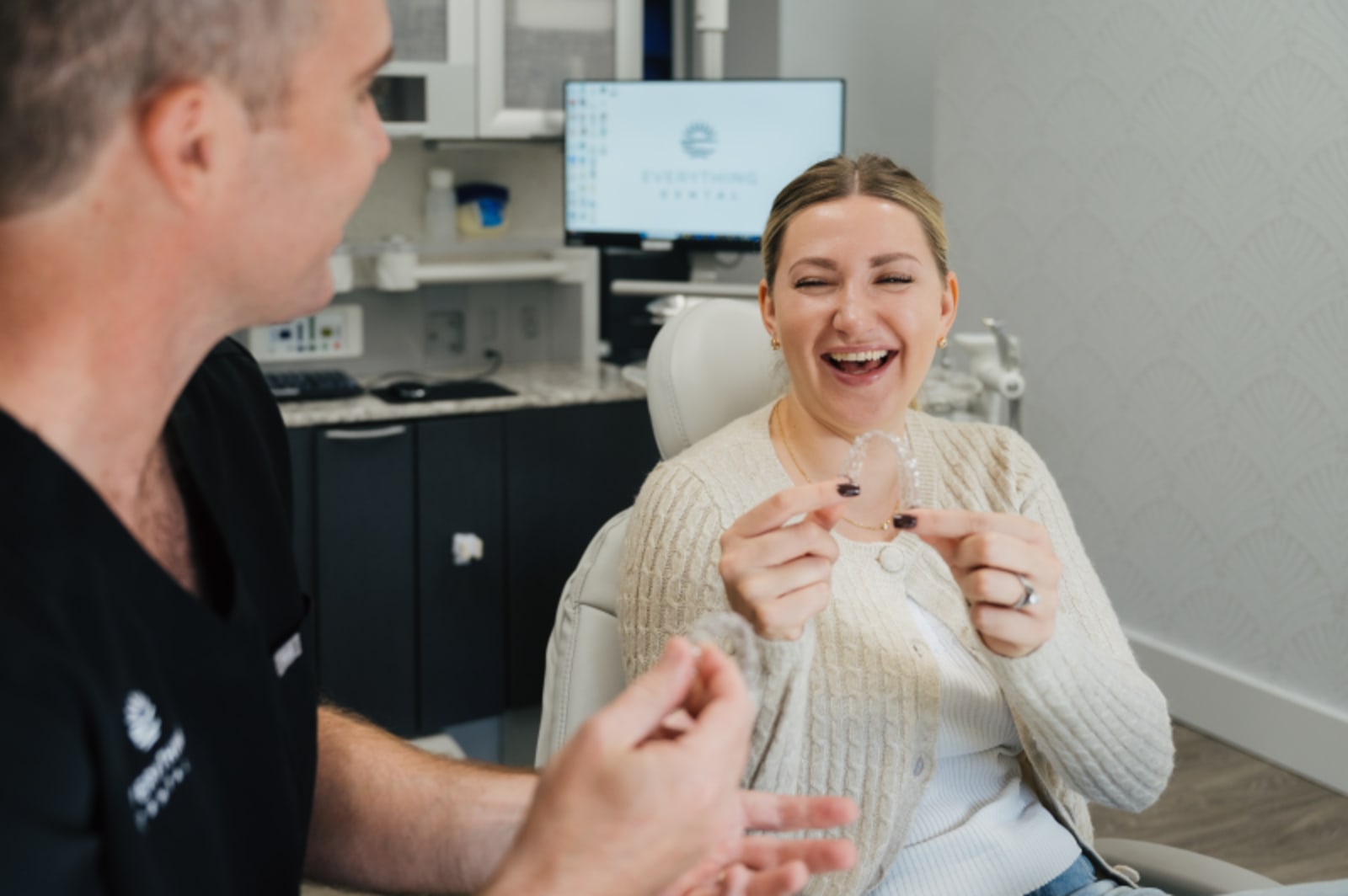
One of the best practical perks of clear aligners is that there are zero food restrictions. Unlike braces, the trays come all the way out when you eat, so popcorn, apples, crusty bread, all of it is fair game. That part is genuinely freeing.
Where patients do feel the shift is in daily behavior. Anytime you eat or drink anything other than water, the aligners come out, and you brush before they go back in. Simple in theory, but it's a habit change that catches some people off guard.
A few questions come up over and over:
- Coffee with them in? No. Heat can warp the trays, and the staining is real.
- Chewing gum? No.
- A quick snack between meetings? Trays come out, every time.
Grazing all day or running on several cups of coffee is worth thinking through honestly before you start. For most people it's not a dealbreaker, but it is a genuine lifestyle change.
Retention: The Part Nobody Mentions Until It's Too Late
What most people don't hear enough about is what happens after the final tray. Teeth move. Bone and tissue around your teeth need time to settle into their new positions, and without something holding the line, they'll gradually drift back. It happens slowly, and it happens to nearly everyone who skips this step.
Retainers are how you protect everything you just invested in. Two common types exist:
- Clear retainers look and feel a lot like your aligner trays and are worn nightly on an ongoing basis. They wear down over time and usually need replacing every year or two, often a few hundred dollars depending on the provider.
- Fixed retainers are a thin wire bonded behind your front teeth. Invisible from the outside and always in place, they require no nightly routine.
Many patients don't realize the retainer can be a separate cost unless someone spells it out early. That kind of surprise at the finish line is frustrating, and completely avoidable. During your free scan consultation, Dr. Fischer puts retainer expectations and costs on the table so nothing blindsides you later.
Another Few Quick Questions That Come Up a Lot
Are clear aligners worth it without orthodontic insurance?
For plenty of people, yes, but the honest answer depends on your case and your budget. During your consultation, Dr. Fischer will lay out the full number and your payment options before you commit to anything, so you're making the call with everything on the table, not guessing afterward.
Clear aligners or Invisalign specifically?
Invisalign is one brand of clear aligner, not a separate category. Which system fits you depends on your bite and treatment goals, and the clinical plan behind it matters far more than the logo on the box.
Do they hurt?
Pressure and mild soreness for a day or two after switching to a new tray is normal. That's the feeling of your teeth actually moving. It eases quickly and is very manageable for the vast majority of patients.
Ready to Get a Real Answer for Your Own Teeth?
At some point, articles and forums can only take you so far. The actual cost, the real timeline, whether aligners even suit your bite: none of that gets settled by an FAQ. It gets settled by someone looking at your teeth.
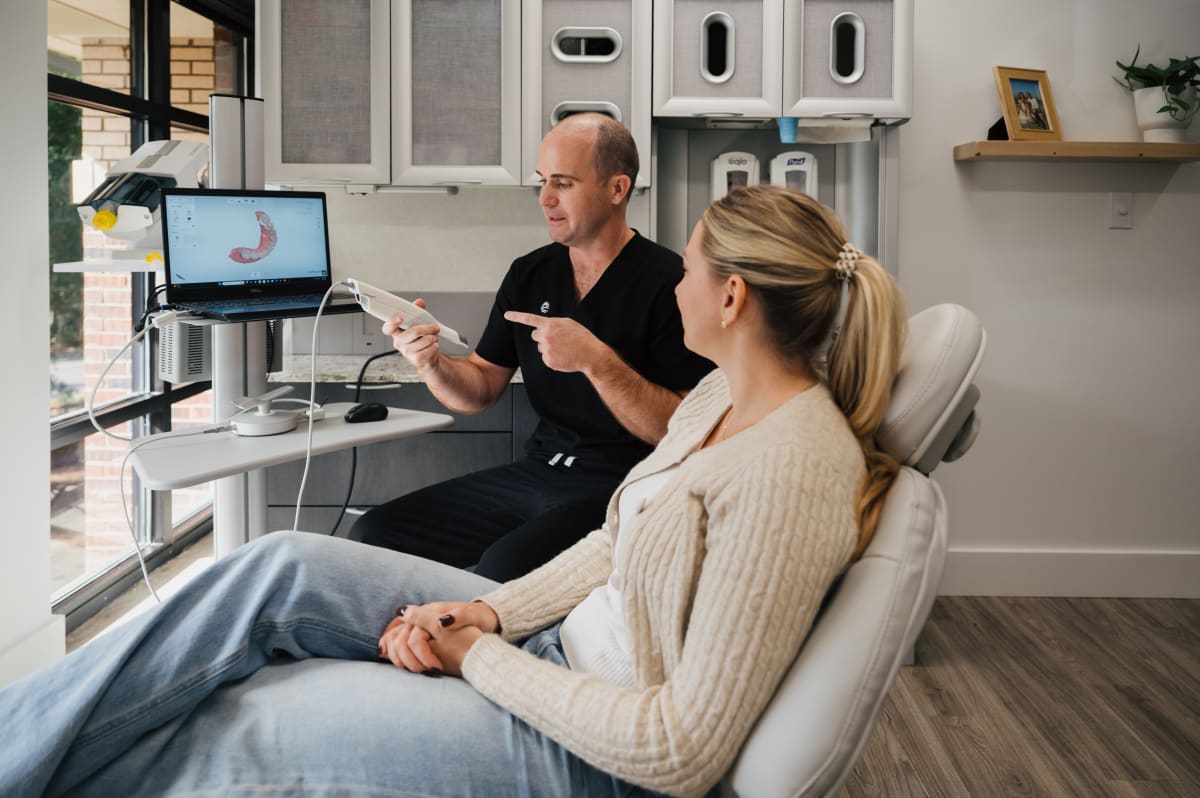
That's where a free iTero scan consultation comes in. No goopy impressions, no guesswork, no commitment. In minutes, the scanner builds a precise 3D map of your mouth so Dr. Fischer can show you exactly what treatment would look like for you, before you've agreed to a single thing.
Past experiences that left you feeling rushed, talked over, or unsure whether you made the right call? You're genuinely welcome here. Most folks who walk in have already done all the research.
Give us a call at (843) 755-6602 or plan your first visit online. Dr. Fischer and the team are here Monday, Tuesday, and Thursday from 8 to 5, and Friday from 8 to 2, right here in Charleston, serving Mount Pleasant and the Low Country.
Connect
with uS
Call 843.471.1677 or request an appointment online to set up your first visit. We’ll be in touch soon.